
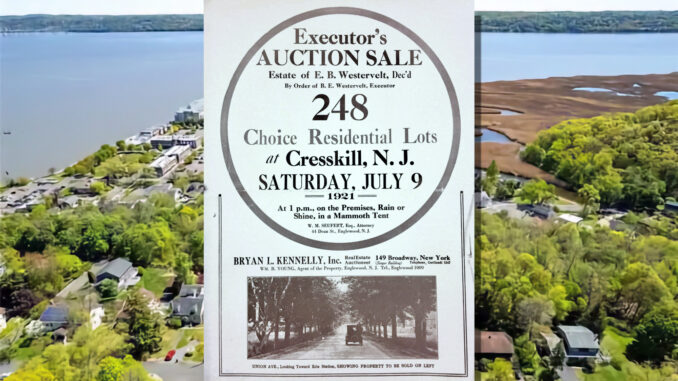
CRESSKILL, N.J.—This week we go back 95 years to the creation of a Cresskill neighborhood. On July 9, 1921, a crowd gathered under a massive tent at the center of Cresskill. Many had come from New York City, eager for a bargain on a building site in the suburbs. That day, 248 residential lots were auctioned off, carved from the estate of the late Edwin B. Westervelt.
Westervelt had owned a large swath of land east of the Cresskill station. Union and Hillside avenues were to the north, Madison Avenue was to the south, and County Road ran through his property. An advertisement for the auction featured a photograph showing Union Avenue as it looked at the time, complete with a Model T traveling up the tree-lined, macadamized road.
The surrounding neighborhoods had been developed in the late 19th and early 20th centuries, in those decades after the railroad came through. Meanwhile, this prime real estate in the middle of Cresskill, long held by the Westervelt family, had remained in its natural state. The Englewood Press described this auction as “one of the most important ever held in Bergen County.”
The Englewood Press wrote on July 2, 1921, “This property which has been in the Westervelt family for over 100 years has never been offered on the market, which is the cause, perhaps, why the attractive little town of Cresskill has never been able to expand as it should. The Westervelt estate property is in the very center of the town and adjoins the Erie station on the west. It is perhaps the only choice tract of land in Cresskill that has not been developed with homes, although it is surrounded on all sides with attractive houses and stores.”
Westervelt had passed away in December 1920 at the 59. He had been one of the first mayors of Cresskill, with the borough ringing in the 20th century with Westervelt at the helm. In the year 1900, during the middle of his tenure, Cresskill had just 486 residents and a total municipal budget of $6,361.
The 1920 census, taken earlier during the last year of his life, lists Edwin, a real estate agent, and wife Margaret living on Westervelt Place (which still exists in town, a connection between County Road and Hillside Avenue). This real estate auction was held about seven months after his death.
The sale was widely advertised in New York City newspapers, an enticement for businessmen to bring their families to the suburbs and become commuters. For the convenience of New Yorkers, free rides by touring car went back and forth between Cresskill and the Dyckman Street ferry boats on the New Jersey side.
Auction notices printed in New York’s largest papers assured potential buyers that Cresskill was not the wilderness, but a thriving little community with convenient railway access, beautiful homes, churches, and stores.
“The lots are in the best residential section of this attractive hometown, which is three miles north of Englewood, one of the most progressive suburban places in the metropolitan area,” wrote the New-York Tribune.
“Most of the lots have improvements such as water, gas, and electricity,” The New York Times reported. “The climate is healthful, the town being situated upon an elevated plateau that lies back of the Palisades of the Hudson River. There are at present many houses in the course of construction in this community.”
Through real estate transactions like the Westervelt auction, Cresskill farmland and acres of forest were transformed into suburban streets, paving the way for the borough as we know it today.
The numbers tell the story: a population of 942 in 1920 had more than doubled to 1,924 by 1930. Of course, we know it did not end there. Nowadays more than 9,000 people call Cresskill home.