
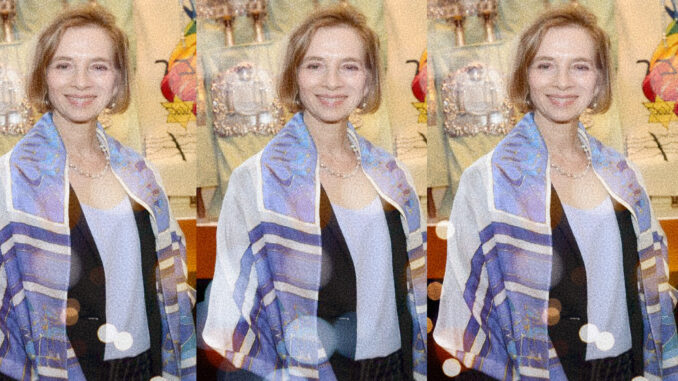
NORTHERN VALLEY—Cantor Nitza Shamah has served Temple Sinai of Bergen County in Tenafly since receiving her cantorial ordination from Hebrew Union College’s Debbie Friedman School of Sacred Music in 1991. At Temple Sinai, she selects, organizes and presents the music for services and programs, working closely with temple accompanist and choral director Cynthia Powell.
She is the founder and musical director of Temple Sinai’s volunteer Rock Shabbat Band, an upbeat Friday-night program that pairs a congregational dinner with a musical service designed to bring the community together.
With support from the Sinai community, Shamah has also produced ongoing musical programs featuring guest composers and instrumentalists.
As a clergy member, Shamah works with Rabbi Jordan Millstein and participates in life-cycle events. She runs the B’nai Mitzvah program and helps prepare students to lead prayers and chant Torah and Haftarah portions, alongside co-teachers Gali Stern and Rabbi Amy Ariel.
She also participates in adult and school-age educational programs and founded and ran an interfaith couples group for parents from different backgrounds who chose to raise Jewish children.
Born and raised in Israel, Shamah completed army service and earned a degree in music education from the Oranim School of Education of the Kibbutz Movement, then completed studies at the Tel Aviv Academy of Music with a degree in musical performance.
In Israel, she was a member of the Cameran Singers ensemble and the Troubadour Quintet. She and her husband raised their twin daughters, now 26, in Nyack, N.Y. She said she feels deeply fortunate and grateful to have been part of the Temple Sinai family and staff for the past 34 years.
Below is my interview with Shamah.
Hillary Viders: You have strong roots in Israel. What was it like serving in the army there?
Nitza Shamah: I was a member of an entertainment group that traveled all over and sang for the troops. It was a unique, inspiring and uplifting type of service, very different from what most young men and women were assigned to do.
HV: When you studied at the Tel Aviv Academy of Music, was it a competitive setting?
NS: I have very fond memories of that time. Needless to say, it was both challenging and rewarding.
HV: Given the constant alert for terrorism in Israel, have you or your family members witnessed anything frightening?
NS: Of course, there were always scary, uncertain and upsetting times in Israel, but nothing compared to what has been going on since Oct. 7.
HV: How did you decide to become a cantor?
NS: Already in New York and trying to explore new singing opportunities, I joined a New York City synagogue choir. This was my first time experiencing Reform Movement-type worship. It was so different from anything I knew back home. The beautiful choral music, the rich sound of the organ, the way men and women were treated as equals, the open-minded, heartfelt spirituality — all that was so fascinating and captivating.
A couple of months later, I applied and was accepted to Hebrew Union College Debbie Friedman School of Sacred Music, a place that has become a wonderful home away from home for me.
HV: Was it difficult to assimilate into the American way of life?
NS: Studying at HUC in a Jewish environment and then moving to Tenafly to become part of Temple Sinai haven’t felt like I needed to assimilate. My Israeli roots have always been a deep source of joy and pride for me, and the Temple Sinai family embraced me just the way I was.
HV: You have sung Hebrew melodies for many years. Do you also sing nonreligious music?
NS: I have always loved the classical vocal repertoire and Israeli popular music, so yes, I have sung nonreligious music as well.
HV: Temple Sinai services with the Rock Shabbat Band are a huge success. Who selects the music that is performed?
NS: That’s a great question. As far as Shabbat prayers, I usually select and introduce the music. We also have a unique custom of picking a popular American song that complements one of the themes of the weekly Torah portion.
I share the content of the portion with the band, and the members of the band suggest a song. In addition, once or twice a year I invite a special singer-songwriter to join the band. The artist shares his or her music and leads the service with us.
HV: You participate in adult and school-age educational programs. What are the most important lessons that you teach?
NS: I try to inspire the kids and the parents to be curious, to keep asking questions, to never stop learning, and to always become suspicious when someone offers them a perfect, final-sounding answer.
HV: What values do you want to pass on to your children?
NS: Morality, self-reflection, a sense of personal responsibility to all life, generosity, and charitable care for others.