
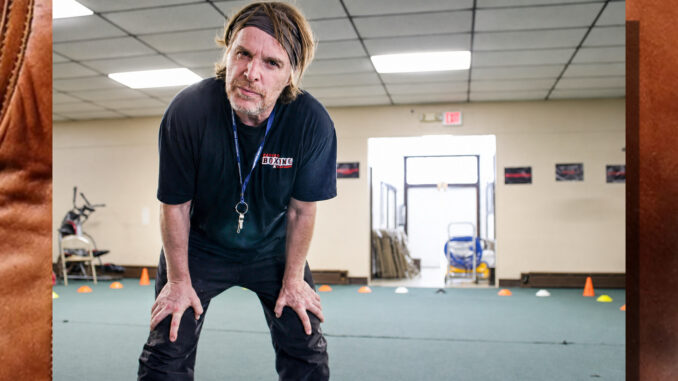
By COACH JIMMY WAGNER
SPECIAL TO PASCACK PRESS
TOWNSHIP OF WASHINGTON, N.J.—As a young man, I was described as mentally wayward, nervous, scared and traumatized. What I eventually learned was that I had obsessive-compulsive disorder — specifically, harm OCD.
I thought nearly everything I did might hurt someone. I worried that I would unknowingly leave the gas on or hit someone while driving. I checked doors 20 times to make sure they were locked. When walking down stairs, I feared I might knock someone over. I could not carve the Thanksgiving turkey because I worried I might hurt someone at the table with the knife.
These were intrusive thoughts. They were not real, did not reflect who I was, and were not things I would ever do.
Still, worst-case scenarios ran constantly through my head. I spent hours each day checking, seeking reassurance and performing compulsive behaviors in an effort to feel certain that I had not hurt somebody.
That is what harm OCD looked like for me.
One therapist introduced me to exposure and response prevention, or ERP. The treatment involves facing a fear and learning to sit with uncertainty without resorting to the compulsive behavior that ordinarily follows.
“The portal of possibility lies in uncertainty,” a therapist once told me.
She was not telling me to fight. But in boxing, wrestling and martial arts, I recognized some of the same principles: focus, attention and the constant need to adapt to changing situations. You have to sort things out on the fly — or simply “sort it out,” as a nun once told me in Catholic school.
Am I going to get punched in the face? Maybe. Given the way I fight, probably.
Can I handle it? Yes.
Each time, I get through it and come out smarter, tougher, braver and better prepared on the other side.
Does that make me a great fighter? Speaking only for myself, no. But it has made me a better person.
It has also made me want to help others — not punch them in the face, but train them in boxing, wrestling and self-defense. I have watched students flip truck tires, work through difficult drills and learn to handle the pressure that comes with pushing themselves.
I am better for it, and I believe my students are, too.
People enter the boxing room carrying all kinds of burdens. It may be OCD, attention-deficit/hyperactivity disorder, depression, anxiety, trauma or hypervigilance. Whatever someone is dealing with, training requires attention and adaptation. What is happening in front of you has to matter.
Losing focus can mean getting hurt or allowing a teammate to get hurt — not because anyone intended harm, but because someone was not paying attention.
In training, we adjust to unfamiliar situations under pressure. We remain in a near-constant state of adaptation, learning what protects us, improves us and makes us more aware.
For me, that process has helped quiet intrusive and unnecessary thoughts.
“Neuroplasticity” is not too big a word for the martial arts room. The brain can reorganize and adapt. Fight training asks us to do that repeatedly through heavy-bag work, sparring, balance drills, wrestling, judo and even flipping truck tires.
Adjusting to constant change requires cognitive flexibility. Fight training has helped me develop that flexibility and strengthen my ability to pay attention.
I have been bettered in boxing, wrestling and judo by people I consider teachers. Many became friends. You learn to trust someone who helps you grow, face the uncertainty of competition and understand what happened after you were knocked down.
My teachers helped me up every time, often with a hug and an explanation.
Through therapy and training, my OCD has become more manageable. Fight training did not replace professional treatment, but it gave me another setting in which to practice focus, tolerate uncertainty and learn that discomfort does not always mean danger.
We do not train to hurt one another. We train for self-defense, awareness, discipline and growth.
A person can gain many of these benefits without sparring, but it requires a consistent regimen and a willingness to be challenged. Your greatest competition is often yourself.
Now go rewire that brain with a good heavy-bag workout. Focus on focusing — and pick up some self-defense skills along the way.
Carry on, my wayward son…
— Coach Jimmy
EDITOR’S NOTE: This week, Pascack Press launches “In My Experience,” an occasional series offering first-person reflections from people with stories and life lessons to share.
Our first contributor is Jimmy Wagner, who was born in 1962 and grew up in Westwood, where his first job was at The Iron Horse. He wrestled at Westwood Regional High School and studied judo under Sensei Nobuyoshi Ogasawara at Kokushi Dojo. Wagner earned a bachelor’s degree in English literature from Montclair State College in 1988 and worked as a stockbroker for 15 years. A boxing coach since 2005, he has operated Pascack Boxing & Fitness [tel. 551-444-2174] since 2017 and began coaching wrestling in 2025.