

WESTWOOD, N.J.—A dentist preparing to open his first Montvale practice sat alongside bankers, financial planners, nonprofit leaders, technology specialists, a plumber approaching his company’s 100th anniversary, a lawyer, a real estate agent and other local professionals Aug. 7 as the Greater Pascack Valley Chamber of Commerce gathered at the Westwood Public Library.
That mix offered a snapshot of the organization the chamber says it is trying to build across the 10 communities it serves: Montvale, Park Ridge, Woodcliff Lake, River Vale, Old Tappan, Hillsdale, Washington Township, Westwood, Emerson and Oradell.
Some in the room had served the chamber for years. Others were attending for the first time.
Brian Roth, a Bergen County native and dentist, told the group he is putting the finishing touches on a new Montvale practice, ARC Dental and Implant Center, he aims to open in October.
“It’s been a dream of mine to kind of open my own practice and connect with my community,” Roth said.
Elsewhere around the room were representatives of banking, wealth management, information technology, office systems, estate and business law, real estate and nonprofit organizations including Meals on Wheels North Jersey and Bergen Volunteers.
Steven Hopper, president of Park Ridge-based Pratt Plumbing Heating & Air Inc., noted that the company will mark its 100th anniversary next year. Janelle Larghi, coordinator of Tri-Boro Food Pantry, and executive director of Meals on Wheels North Jersey, described an organization serving residents in 32 northern Bergen County communities and said she is working to increase public understanding of whom Meals on Wheels can serve.
Beth Figman, a Bergen Volunteers board member attending as a guest of chamber President Anthony Rizzo, had a particular interest in the morning’s program: Bergen Volunteers is planning an Oct. 23 breakfast focused on AI, and she said she hoped to connect with Scheufele after hearing her presentation.
That range of businesses and missions made the morning’s guest topic unusually broad: what artificial intelligence can actually do for an organization once the novelty of asking a chatbot questions wears off.
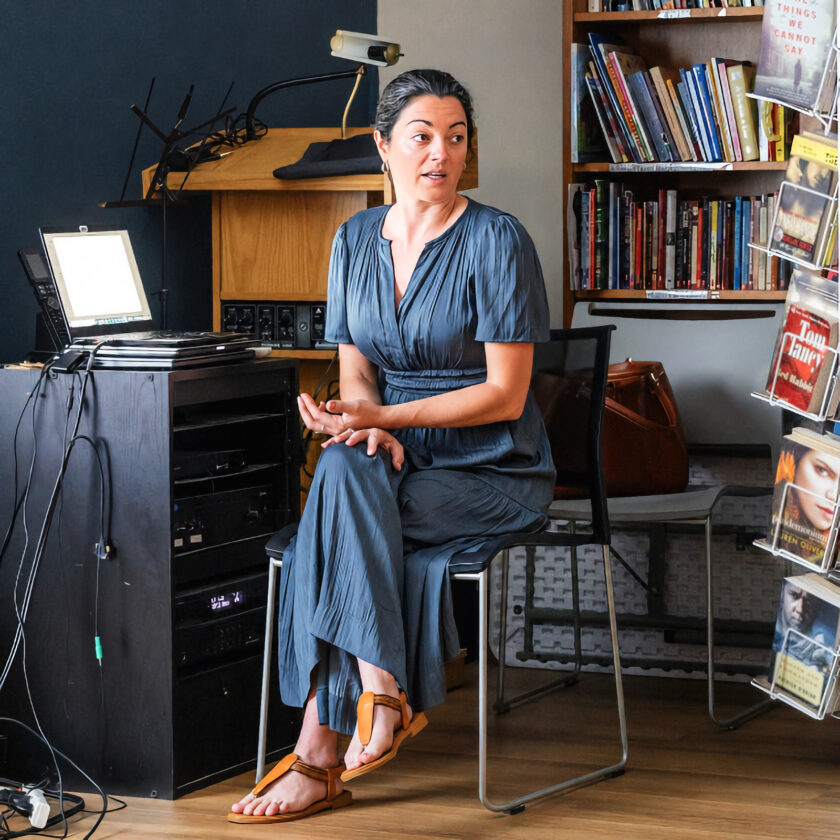
Kris Scheufele, founder and principal of Wyckoff-based NJ Business AI and a board member of the Waldwick Chamber of Commerce, spent about half an hour demonstrating ways businesses can use AI not simply to generate text, but to perform and organize work.
Her message was essentially that business owners should think of AI less as a single chat window and more as an increasingly capable assistant — one that can be given defined jobs, connected to other workplace tools and supplied with business data.
Scheufele demonstrated Claude, Anthropic’s AI platform, including “skills” that can give the system standing instructions for a particular task.
She compared a skill to a recipe card: a business could, for example, create instructions defining its brand voice, then reuse those instructions whenever it asks the system to produce marketing material.
She also showed members how AI systems can connect with email, calendars, cloud storage and design platforms, and how scheduled tasks can automate recurring work.
One example from her own workflow is a Monday-morning review that checks for messages requiring follow-up and helps prepare responses.
Members quickly supplied examples from their own experience. One said he uses AI to improve emails by asking it to make them more professional. Another described using it for marketing, inventory control and projections — while adding an important caveat: “It’s a tool. It’s not a Bible.”
Scheufele agreed with the underlying point. Users do not have to master every feature, she said, and can begin by asking the AI itself what might be useful for a particular business or job.
Her demonstration moved from writing assistance into more ambitious territory.
Using a browser extension, Scheufele showed how an AI assistant could review publicly available social-media material, identify patterns in successful posts and help turn those findings into a content plan. She demonstrated the concept using Meals on Wheels as an example, asking the system to examine related organizations and meal-delivery accounts for ideas.
That research, she said, could then be combined with social-media scheduling software to prepare weeks of posts at once.
But Scheufele placed particular emphasis on something considerably less flashy: business data.
“If you leave here with nothing else, you should at least have a handle on your data and understand what you can do with that data using AI,” she told the group.
She walked members through three Google tools: Google Business Profile, Google Search Console and Google Analytics.
A Google Business Profile, she said, should not be treated as a static listing. Businesses can post updates there much as they do on social media and review such information as calls and website clicks.
Google Search Console, meanwhile, can show the actual queries people use to find a business, along with impressions, clicks, click-through rates and search positions. Exporting that information and giving it to an AI system can help a business identify where its online visibility might be improved.
Sometimes, Scheufele said, the answer is not producing large amounts of new material but making targeted changes to such basics as page titles and descriptions.
She also encouraged businesses with websites to publish useful, current information addressing the problems customers are trying to solve — rather than writing exclusively about the product they hope to sell.
For one durable-medical-equipment client, she said, content about such subjects as swollen legs and how to measure for compression socks reached people earlier in their search for help than product-centered marketing alone.
Following the presentation, members asked about automating newsletters and email campaigns. Scheufele suggested creating reusable brand-voice instructions from examples of a company’s own writing, then using those instructions to draft an email series while leaving delivery to a dedicated email platform.
The breadth of the presentation prompted one member to suggest the subject could easily fill an entire workshop.
“That’s the tricky part” of a short presentation, Scheufele said. The objective is less to teach every workflow than to “open up possibilities.”
What about unintended consequences?
The chamber discussion came as questions about AI’s speed, power and consequences were moving well beyond the technology sector.
Just three days earlier, U.S. Rep. Josh Gottheimer, whose 5th District includes much of northern Bergen County, called for mandatory “rules of the road” governing advanced AI systems.
In an Aug. 4 statement supporting the “Pacing the Frontier” petition signed by more than 1,300 employees at major AI labs, Gottheimer said the United States should continue to lead in AI innovation while developing safeguards for national security, critical infrastructure and other high-risk areas.
“America must lead the way in AI innovation, but we have to do it responsibly,” Gottheimer said. “We can’t let the AI industry run wild.”
At the Westwood meeting, the concern was closer to the everyday workplace.
After Scheufele’s presentation, Pascack Press asked about a different consequence of those efficiencies: Many of the tasks AI can now perform — organizing information, drafting routine material and handling administrative work — traditionally have fallen to interns and entry-level employees, giving newcomers a way to learn a profession. Does automating that work risk eliminating the bottom rungs of the career ladder?
Scheufele said she does not view AI as a substitute for the human element of a business or profession. Its strongest use, she said, is in reducing the time spent on repetitive and technical tasks.
She said AI can facilitate such work as organizing, outlining and assembling information, but that the remaining human contribution — judgment, creativity and the actual craft of writing — retains its importance.
Asked specifically about journalism, Scheufele said she believes the proliferation of AI-generated content could actually increase the value of original reporting and distinctly human work.
“I truly believe that it’s going to make journalism more valuable,” she said, arguing that material lacking genuine reporting makes “the real stuff that much more important and valuable.”
For businesses, she said, the central benefit is saving time on “arduous tasks that are monotonous and repetitive” and allowing people to concentrate on work humans do particularly well.
“All operations,” she said, “can be improved and enhanced.”
Chamber plans for Citizens of the Year gala
The meeting also turned to the chamber’s own coming work.
President Anthony Rizzo said the organization is preparing for its 52nd Citizens of the Year gala at Seasons in October. The chamber has selected two 2026 honorees: Theresa Capparelli, a nonprofit leader and chamber board member, and Dr. Peter Wohl, CEO and owner of The Spine & Health Center of New Jersey.
Rizzo said last year’s gala drew about 175 people. Proceeds help support charities selected by the honorees as well as the chamber’s scholarships for high school seniors in each of the 10 communities it represents.
Members will spend the coming weeks seeking sponsors, program advertising and silent-auction donations from businesses throughout the Pascack Valley.
It was another illustration of the chamber’s stated mission: business networking tied closely to community involvement.
“We’re not just doing it for ourselves,” Rizzo told members. “We’re really doing it for the places we live and serve.”