
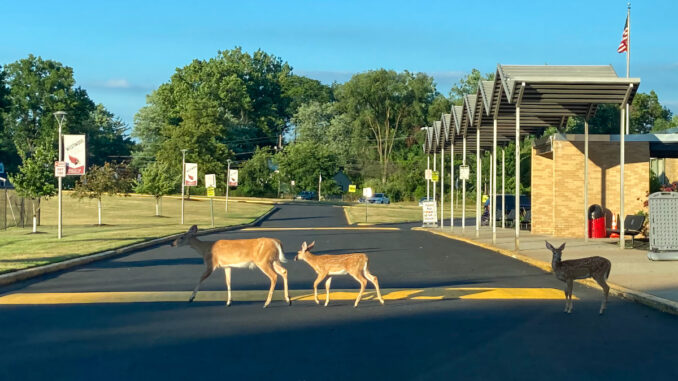
HACKENSACK, N.J.—Some Pascack Valley and Northern Valley town councils are “respectfully requesting” that the Bergen County executive and commissioners begin to undertake a regional approach to deer population concerns and develop effective deer management strategies that can be implemented countywide.
Several towns, including Old Tappan, Montvale and River Vale, have passed similar resolutions calling on county government to address the deer population on a regional basis and assist the region’s towns in dealing with a growing problem.
Other towns considering resolutions to pressure county officials to help them with deer population management include Hillsdale, Northvale, Harrington Park and Haworth, said Old Tappan’s mayor, who sent copies of a resolution passed in Old Tappan to more than a dozen fellow mayors in the Pascack and Northern valleys.
“The buck stops with him (County Executive James Tedesco III),” Gallagher said. He said county government has a parks department and also controls many acres of land, including golf courses, that might be evaluated for possible deer management measures.
He said the increasing numbers of deer, deer-spread Lyme disease, damage to residential landscapes and grounds, increased risk of deer-vehicle collisions, and increased public safety risks from deer-vehicle accidents are taking a toll on area residents.
Gallagher noted, “Yes, we do have a problem. After the experts do some research, maybe we can explore what some options might be on a countywide, regional basis,” he said.
Pascack Press reached out to County Executive James Tedesco III and county commissioners for comment on the resolution.
In a Sept. 30 reply letter from County Administrator/Counsel Thomas Duch to Old Tappan, obtained by Pascack Press, Duch advised the borough that the state Department of Environmental Protection Community-Based Deer Management Program offers “an existing framework for municipalities seeking to address significant deer-related impacts.”
Duch wrote, “Decisions regarding deer management and the implementation of any management strategies remain under the jurisdiction of the individual municipalities and applicable state agencies. We appreciate the borough’s efforts to bring this issue forward and trust that the information provided will be helpful as the borough considers options available to address its local deer management concerns.”
Last year, Hillsdale and Montvale conducted deer drone studies that showed deer populations far exceeding the biological “carrying capacity” of land, which is about 8–10 deer per square mile. Hillsdale’s study found about 38 deer per square mile, and Montvale’s study found about 78 deer per square mile. See “Deer count above average in Hillsdale, Montvale,” by Michael Olohan, March 19, 2026, at thepressgroup.net.
In addition, to seek residents’ feedback on deer management, Hillsdale Mayor Michael Sheinfield has scheduled a deer town hall for Monday, Oct. 5, at 7 p.m. at Borough Hall to discuss the drone survey and seek consensus on possible local/regional deer population controls.
Old Tappan Mayor Thomas Gallagher told Pascack Press that after the council passed a resolution Sept. 21 requesting that the county get more involved in deer population and deer management concerns, he sent the resolution to other mayors, hoping to build momentum for a regional and countywide effort to better manage the deer population.
In his email to more than a dozen mayors, Gallagher wrote, “Attached is a Resolution passed last night in Old Tappan requesting Bergen County involvement in controlling the ever expanding deer problem in our community. Please consider (it) for your communities and request County involvement.”
“I hope that the county at least acknowledges there is an issue here, and that maybe they need to do something. For them not to deal with this is irresponsible,” Gallagher told us. He said maybe they can initially start an exploratory committee looking into the problem and report back to the public.
Gallagher said the deer overpopulation issue was getting more and more attention, and that the NJDEP senior biologist who spoke in Old Tappan last year advised thinning the herd. However, how that’s done remains a contentious issue, with residents advocating for lethal and non-lethal means struggling to find common ground and ways to address the problem.
He said no one wants their child in a vehicle collision caused by a deer, if possible. He told Pascack Press that one resident told him that their car insurance dropped them after his wife and son were both involved in deer-vehicle collisions.
He said he hoped Bergen County officials see the need to get involved. “This is an issue in every town and it’s not just about somebody’s flowers being eaten,” Gallagher said. He noted that white-tailed deer have no natural predators around anymore.
The resolution notes that “increasing deer populations may contribute to public health and safety concerns, including the accumulation of deer droppings in public areas and fields used by children, the potential spread of disease, and other environmental and sanitary concerns; and (that) the increasing deer populations have contributed to an increased risk of motor vehicle accidents involving deer, thereby presenting a concern for motorists, pedestrians, and the general public.”
The River Vale resolution noted, “that the Township hereby respectfully requests that Bergen County monitor deer populations and their impact on public safety, vegetation, natural resources, and property throughout Bergen County (and) that the Mayor and Council respectfully request that Bergen County coordinate with municipalities throughout the County to evaluate the scope of the regional deer population and develop appropriate, effective, and financially responsible regional deer management strategies.”